
Something you should know about me: I am a bit of a goal-setting fanatic. I use the PowerSheets system from Cultivate What Matters, and I’m sure I will be posting about that process soon.
There’s another thing you should know about me, though: I am a “starter.” I mentioned this in Post #3. I love to get excited about new things. I love to dream and plan. I buy new calendars, planners, and notebooks. I get all organized, and then, I run out of steam. This leads to feelings of guilt and failure.
I also struggle with Bipolar disorder which can effect my ability to be productive. I discuss this and other challenges that come along with my Bipolar disorder in Post #7.
One thing that has helped me with these struggle is my belief that life is made up of seasons. Some are busier, more stressful, more draining, or more confusing than others. Some lend themselves to the time and mental space to work toward big goals while others leave you feeling like you have nothing left to give. Choosing to live in light of the realities of the season you are in right now can lead to great peace.
This belief has been especially comforting to me as we have experienced our infertility journey (read more in Post #4).
Now, I did not come up with this idea of seasonal living. It’s actually a Biblical concept (which I discuss more further down). The Church has long modeled her calendar around this concept. I mentioned at the beginning of this post that I use the brand Cultivate What Matters to help me set goals. This brand talks about living in seasons quite a bit and uses a quarterly system to evaluate the seasons of life. In their daily planner (aptly called the Season by Season Daily Planner), there is a two page spread entitled “Weekly Rhythm Ideas for the Season.” This spread occurs every three months to encourage evaluating whether the rhythms of our lives are working for us. In their goal setting system PowerSheets, there is a section every three months to evaluate progress in each of eight life categories and refresh the yearly goals that were set. I have also mentioned Kendra Adachi (The Lazy Genius) who discusses seasonal living in her book The Plan. As you can see, this is not an idea that originated with me. I do think it is interesting to look into the roots of this philosophy, though.
Three places I see seasonal living modeled is in science, psychology, and theology.

The year moves through seasons. The experience of these seasons varies drastically depending on where you live. Here in Mobile, Alabama, it can feel like there are only two seasons sometimes: Summer and a short, mild Winter. There are, in reality, four seasons, of course. Each season has significant meanings attached in literature and art. The spring often represents birth, fertility, youth, and possibility. The summer stands for new adulthood, passion, love, and freedom. Fall can symbolize middle-age, harvest, reflection, and weariness. Finally, winter shows old age, unhappiness, and death. All of these stages are beautiful pieces to the puzzle of life, and they are each unique. They each have their own joys and challenges.
The physical seasons can affect productivity. Some people struggle with seasonal affective disorder where the changing of certain seasons can lead to feelings of depression. The cold days of winter can put goals of fitness and outdoor exploration on hold if you live in an area where the weather conditions are not conducive to being outdoors during that time.
During my first and second year of college, I experienced severe seasonal affective disorder. I had moved from Alabama to Pennsylvania. I had never seen a northern winter, and the cold temperatures, lack of sunlight, and snow hit me hard. Even now that I am back in Alabama, I still struggle with decreased energy and more frequent feelings of sadness when the weather is colder. It took me a while to begin accepting this reality and using the awareness in my planning. I give myself more time to rest, less activities, and fewer goals during these times. I adjust my expectations to be more realistic.

Developmental psychology breaks the life cycle into seasons, as well. Theorists typically call them “stages”. Different practitioners define the stages in varying ways, but most follow the same major themes: infancy, childhood, adolescence, adulthood, and aging. Recently many theorists are adding an emerging adulthood category between adolescence and adulthood which I find interesting. Within these groups are some subgroups. For example, middle schoolers are developmentally different from high schoolers, though they both fall in the category of adolescence.
It should be noted that all of these stages are vaguely defined. Some children exhibit behaviors typical to adolescence while some adolescents exhibit behaviors typical of childhood. The infancy stage lasts longer for some. Some people would be categorized as adults by some theorists, but other theorists might still classify them as adolescents. Despite these ambiguities, the categories can be helpful because they point out that there are seasons of life where big changes occur, and some expectation adjustments should probably accompany these big changes. A very successful college student may struggle to adjust to life after college. A busy mom of teenagers may flounder when she finds herself with an empty nest.
Living realistically based on our current season just makes sense to me. A new mother’s social calendar is not going to be able to look like an empty nester’s. A newly married woman will likely not prioritize her personal goals the way she did when she was single or dating. Our lives change based on what season we are in.
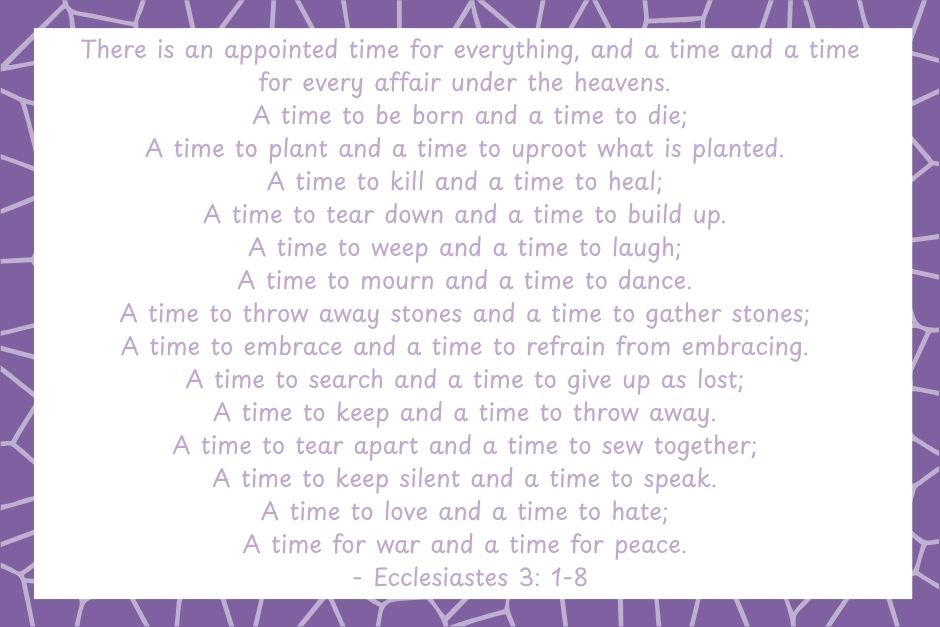
Scripture talks about there being different seasons in life. The biggest example I can think of is one of my favorite Bible verses is Ecclesiastes 3.
In addition to Scripture, the calendar of many Christian denominations also sets a rhythm of seasons. The liturgical seasons of Advent, Christmas, Ordinary Time, Lent, the Triduum, and Easter provide the ability to focus on fasting, feasting, and growth in a pattern that repeats year after year. I love that I can lean with trust upon the Liturgical Calendar knowing that it will lead me through seasons when I focus on different aspects of my faith. If I don’t have a particularly great Lent or Advent, I know the next one will come around in a year with all the opportunities to surrender myself to prayer, fasting, and almsgiving. If I feel like I got carried away in all the to-do lists of Christmas and did not enter into the joy of the season in my prayer life, I know that Easter will be coming with another opportunity to celebrate! Ordinary time is broken into two sections, and I am offered the opportunity to work on my daily habits that undergird my life of faith during this time. I plan to do a post on the liturgical calendar as Advent comes around. In the meantime, you can see some of my favorite liturgical living books on my Favorite Things page.
I find that there is much to learn about seasonal living. Each time I feel like I am mastering this approach, something new reveals itself to me. In true liberal arts fashion, I am particularly interested in what science and psychology can contribute to the use of seasons in the theological field. I really enjoyed reading Stages of Faith by James W. Fowler for my Religious Education course during my Master’s in Theological Studies. He intersects theories about cognitive, social, and psychological stages with what he has observed in the development of faith.
One of the practical examples of these intersections can be seen in the case of sacramental preparation. Many churches distribute sacraments to groups of kids based on what grade they are attending. The ambiguities noted above about some children reaching certain stages before or after others has led me to begin questioning whether children should receive sacraments when they show particular signs of preparedness, regardless of their age or grade. I think there are many connections that can be made between the large body of psychological research, the natural world, and how we live our lives.
As a last note, I want to share a quote from Jennifer Roskamp at The Intentional Mom:
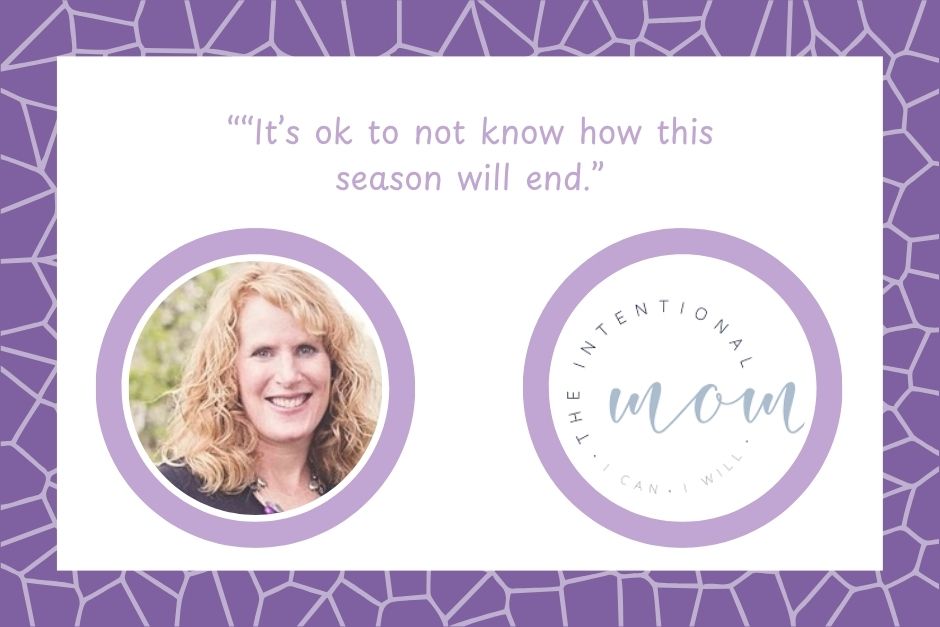
This permission is incredibly freeing for me. It ties in with how I named this blog Mission Today. For today, I can choose to live in this season and set aside all the uncertainty that comes with future seasons. I can choose rhythms that bring me peace in this season, and then be willing to change them when they are no longer serving you. I can hope for great things to happen in the future that don’t fit into this season. I grieve hard seasons and rejoice in joyful ones. I can live fully today, trusting that I will know when it is time to start a new season. I can enjoy this season while its here and learn all the lessons it has for me.

 Mission Today